
Phonetic and phonological contrast of nasals m, n, and ñ in English, Spanish, and Kichwa
DOI:
https://doi.org/10.69850/rimi.vi1.211Palabras clave:
Kichwa, phonetics, phonologyResumen
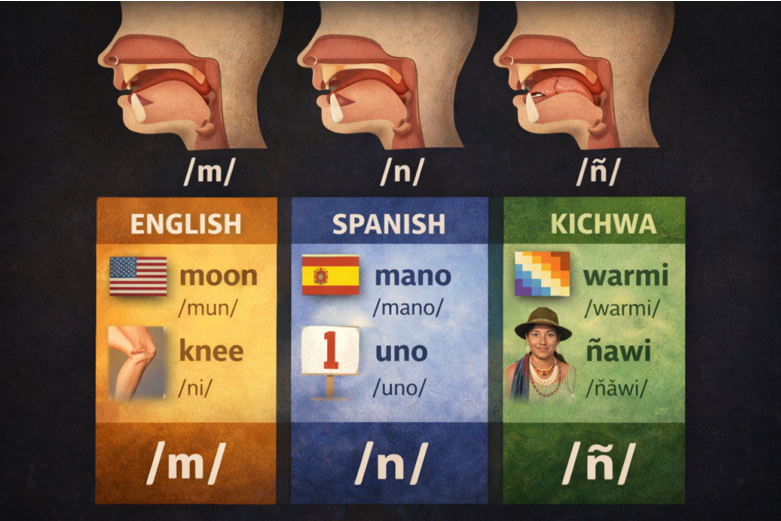
This study analyzes the phonetic and phonological contrast of the nasal consonants /m/, /n/, and /ɲ/, represented by the graphemes m, n, and ñ, in English, Spanish, and Kichwa. The research adopts a qualitative, descriptive, and contrastive approach aimed at examining phonological distribution, allophonic variation, and interlinguistic transfer phenomena, with particular emphasis on Kichwa–Spanish bilingual speakers. From a constructivist perspective, linguistic knowledge is understood as being constructed through interaction among phonological systems in contact. The results reveal significant differences across the three languages. In English, nasal consonants exhibit largely total phonological distribution and a wide range of phonetic realizations conditioned by phonotactic and prosodic factors. Spanish occupies an intermediate position, characterized by stable phonological distributions and predictable assimilation patterns. In contrast, Kichwa displays partial phonological distributions and highly systematic patterns of complementary allophony shaped by historical, etymological, and orthographic principles. Additionally, processes of positive transfer are identified when phonological similarities exist across languages, whereas zero transfer occurs when sounds are exclusive to a single language. The phoneme /ɲ/ does not exist in English but shows similar phonological behavior in Spanish and Kichwa, despite exhibiting relevant phonetic divergences. These findings contribute to the understanding of language contact and provide valuable insights for contrastive phonology and bilingual education.
Descargas
Publicado
Número
Sección
Licencia
Derechos de autor 2026 René Mauricio Matabay Cargua

Esta obra está bajo una licencia internacional Creative Commons Atribución-NoComercial-CompartirIgual 4.0.

